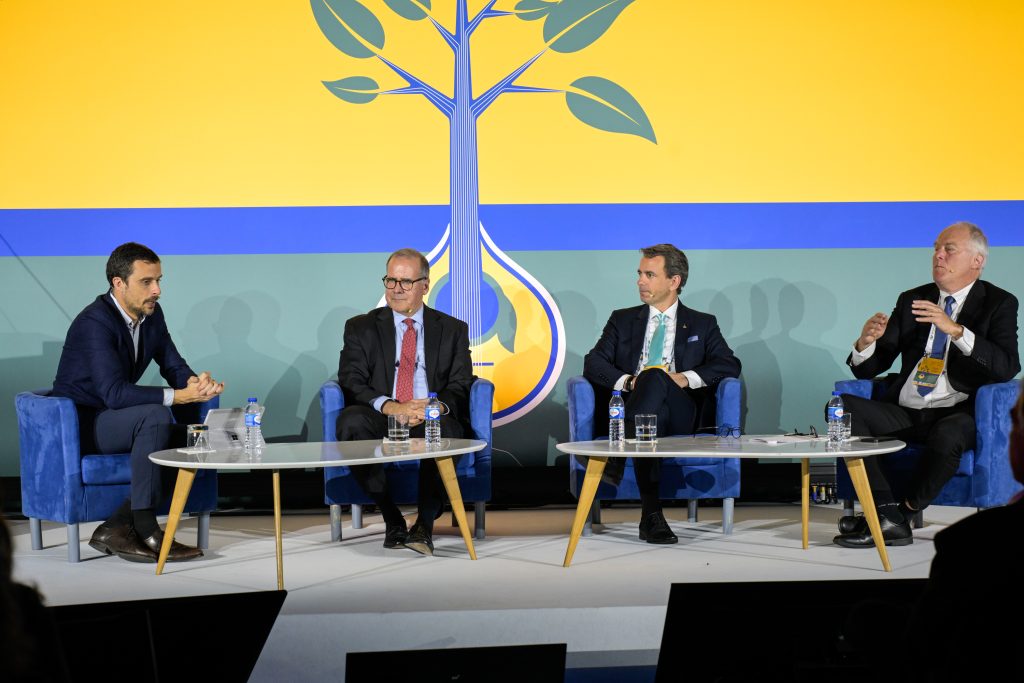
At the World Seed Congress 2026 in Lisbon, a panel discussion on international trade, climate change and plant health explored how the seed sector can help deliver food security in an increasingly complex global environment.
Featuring Enrico Perotti, Secretary of the International Plant Protection Convention (IPPC), Lloyd Day, Deputy Director General at the Inter-American Institute for Cooperation on Agriculture (IICA), and Henrique Alves, Global Regulatory Strategy Executive Manager at GDM Seeds and ISF Board of Directors member representing Brazil, the session focused on a central message: while agriculture is facing the pressures of climate change and geopolitical disruption, it is also a critical part of the solution, and ensuring plant health is key to provide farmers with the solutions they need to build resilience.
Agriculture as a Solution Provider
The panel emphasized that food security begins with seed. As climate pressures intensify and the global population continues to grow, farmers will need access to innovation that helps them produce more reliably, sustainably and efficiently.
“Agriculture is not a problem. It’s a solution. And that solution begins with the seed.” – Lloyd Day, IICA
For the seed sector, this reinforces its role as a “delivery mechanism for innovation,” as noted by Lloyd Day. Improved varieties, new genomic techniques, plant health safeguards, and better agronomic practices all begin with the ability to move seed safely and predictably across borders.
Harmonization vs Fragmentation
A major theme was the growing tension between national self-reliance and global interdependence. While many countries are understandably concerned about food security, biosecurity, and sovereignty, it can become a barrier when this leads to protectionism or inconsistent regulatory barriers, which can slow innovation and disrupt trade.
The panel called for regulations that are risk-based, science-driven, and proportionate. Predictable rules are essential for seed companies, farmers, and governments alike. They help ensure that plant health protection does not become an unnecessary obstacle to agricultural progress. Such regulatory harmonization, especially at the global level, is crucial for trade and for seed movement.
“A guitar string when it’s free, it can wiggle everywhere but it doesn’t produce any music. It’s when it’s bound that it produces music… The IPPC is one of these strings that produces rules that instill harmony in trade.” – Enrico Perotti, IPPC Secretary
Digital Tools for Smoother Trade
The session also highlighted the value of digitalization, particularly the IPPC ePhyto solution, which enables the electronic exchange of phytosanitary certificates. For the seed sector, the IPPC ePhyto Solution offers a practical way to streamline cross-border movement, reduce paperwork, improve transparency and prevent costly delays.
Digital phytosanitary systems can also reduce opportunities for corruption and strengthen trust between trading partners. In a sector where timing is critical, avoiding unnecessary delays can make a significant difference for farmers and markets.
Continued investment in research was another priority. New genomic techniques, regenerative agriculture and advances in plant breeding can help farmers adapt to shifting environmental pressures while improving yield stability.
“We cannot imagine a better goal than produce more yield or stability at the same area with the same inputs. This is our main goal.” – Henrique Alves, GDM Seeds
This is the practical promise of innovation: producing more from existing resources while reducing pressure on land, water and ecosystems.
A Shared Responsibility
The panel concluded with speakers emphasizing that the future of the seed trade depends on cooperation among governments, international organizations, researchers, companies, and farmers.
Science-based regulation, harmonized standards, digital trade tools, and continued research investment are not separate priorities. Together, they form the enabling environment that allows healthy seeds and innovation to reach the people who need them most.
In a changing climate and a fragmented world, the seed sector’s task is to keep innovation moving — safely, responsibly and globally.