Hot Topics

A Practical Guide
Supporting responsible practices across seed value chains
Navigating Social Rights and Ethical Practices in the Seed Sector: A Practical Guide, published by the International Seed Federation, intends to contribute to the extensive work that has already been carried out in the seed sector, including seed companies, associations and smallholder growers on social and environmental responsibility. Rather than duplicating these efforts, these guidelines aim to build upon and complement existing publications and guidance available by providing a pragmatic framework for seed companies, suppliers, and industry associations to uphold responsible labour practices and meet international social standards. Special focus has been placed on efforts related to raising awareness and capacity building, as these are considered particularly effective regarding long-term and sustained change.
A Practical, Voluntary Resource
These guidelines are intended as a voluntary, practical tool to help stakeholders across the seed sector implement responsible labor practices and align with international social recommendations and standards. ISF recognizes that many companies and organizations already have robust social compliance and responsible sourcing programs in place. The document is designed to complement existing practices, reinforcing those efforts rather than replacing them, with a strong focus on awareness-raising, capacity building, and continuous improvement for organizations that are still building capacity.
Why does this guide matter?
Responsible seed sector practices are essential to resilient and sustainable value chains. Social rights and ethical business conduct are not separate from the seed sector’s contribution to food security and sustainable agriculture; they are part of the foundation for long-term trust, collaboration, and impact.
Seed companies and associations operate in diverse markets, production systems, and regulatory environments. Many already have policies, programmes and partnerships in place. Others are beginning to formalize their approach. This guide is designed to support organizations at different stages of their sustainability journey by offering practical orientation, common language, and accessible learning tools.
Who is it for?
The Practical Guide and e-learning course are intended for a broad range of users across the seed sector, including:
- Seed companies seeking to strengthen responsible practices across their operations and value chains.
- National and regional seed associations supporting member awareness, dialogue and capacity building.
- Sustainability, compliance, procurement, human resources and production teams working on social responsibility topics.
- Managers and staff who want a clearer understanding of social rights and ethical practices in the seed sector.
- Partners and stakeholders interested in practical approaches to responsible seed value chains.
What does it cover?
The Practical Guide introduces key concepts and practical considerations related to social rights and ethical practices in the seed sector.
It supports users in understanding:
- What social rights and ethical practices mean in the context of seed value chains
- Why these topics matter for companies, associations, workers, growers, farmers, communities and the wider sector
- How organizations can identify relevant issues in their own operations and partnerships
- How responsible practices can be integrated into policies, procedures, training, engagement and decision-making
- How collaboration and continuous learning can help strengthen responsible value chains over time.
E-Learning Course
The guide is accompanied by an e-learning course designed to help users engage with the material in a structured and accessible way.
The course supports individual and team learning by introducing core concepts, practical examples and reflection points. It can be used by companies and associations as part of internal awareness-raising, staff training, onboarding or broader sustainability capacity building.
Webinars
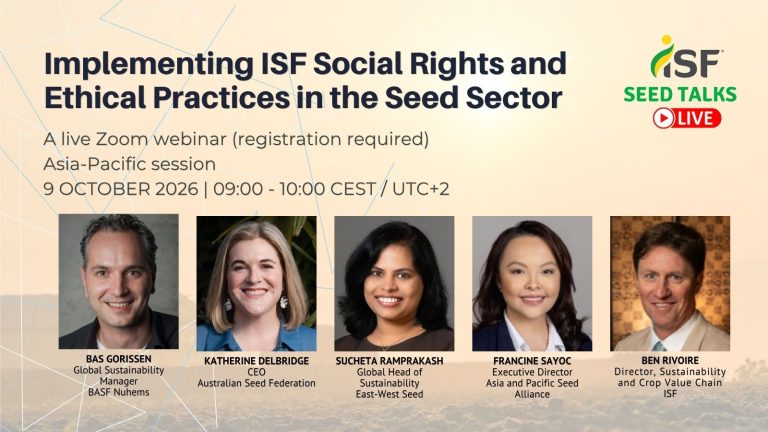
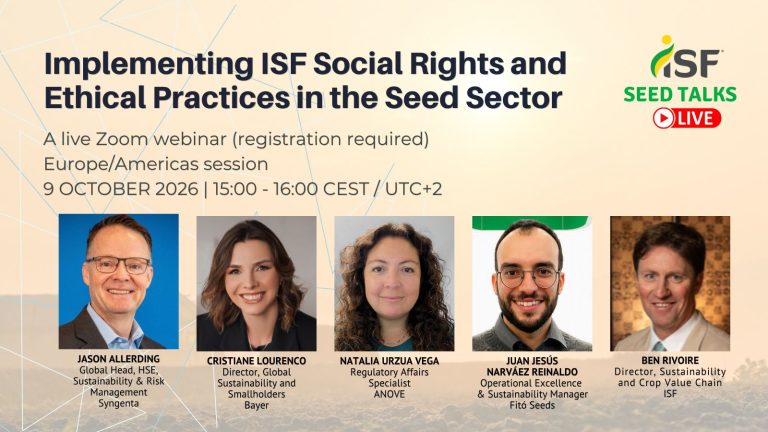
ISF invites members and partners to join the Seed Talks, “Implementing ISF Social Rights and Ethical Practices in the Seed Sector,” taking place on October 9, 2026, on two time slots to encourage broad participation across time zones:
- 9:00-10:00 AM CEST – Register Here
- 3:00-4:00 PM CEST – Register Here
As social responsibility becomes an increasingly central expectation across agricultural and food value chains, seed companies are being asked to demonstrate not only product quality but also the integrity of the practices behind it. This webinar will walk participants through how to put ISF’s social rights and ethical practices guidance into action within their own organizations, covering practical steps for assessment, implementation, and ongoing due diligence.
Registration is open now, and attendance is free. Seats are limited, so all are encouraged to register early to secure their place.
Disclaimer
This document has been developed as a voluntary guidance tool intended to support seed companies, associations and growers in the seed sector in understanding and implementing responsible social and ethical practices. It does not constitute, and should not be interpreted as, a document providing advice or as a substitute for professional legal counsel. The contents herein are for informational and educational purposes only. Users are encouraged to refer to applicable national laws and regulations for binding legal requirements.
For all inquiries, please contact Ben Rivoire of ISF at b.rivoire@worldseed.org