At the World Seed Congress 2026, the panel discussion “Beyond ESG: What Sustainability Really Looks Like for Agriculture” explored how the seed industry and the broader agriculture sector in general are moving from sustainability as a reporting exercise to a practical foundation for resilient business, responsible operations, and farmer support.
The discussion made clear that environmental, social, and governance frameworks remain important, but reporting alone is not enough. True sustainability must show up in the field, in supply chains, in workplaces, and in farmers’ and companies’ ability to keep operating under increasingly difficult conditions.

Sustainability as Business Resilience
Farmers and seed companies are navigating climate uncertainty, rising production costs, resource constraints, labor challenges, and evolving market expectations. Sustainability is therefore not separate from business strategy; it is central to long-term resilience.
“Being sustainable means being able to stay in business.” – Justin Davis, COO, Sakata Seed America
For the seed sector, this means developing products and practices that help farmers produce more reliably, use resources more efficiently, and adapt to changing growing conditions.
The panel emphasized that compliance and reporting are necessary, but they cannot solve systemic challenges alone. Issues such as food security, climate adaptation, resource efficiency, and labor rights require collaboration across the value chain.
This is where pre-competitive cooperation becomes essential. Companies can compete in the market while still working together on shared challenges that affect the sector’s credibility, resilience, and future.
The discussion also highlighted the risk of overburdening farmers with multiple standards, audits, and reporting systems. Harmonization can help reduce duplication while maintaining trust.
Practical Tools and Credible Standards
The Consumer Goods Forum’s Sustainable Supply Chain Initiative (SSCI) was presented as one example of how benchmarking and harmonized standards can support more practical sustainability implementation.
Rather than focusing solely on whether processes exist on paper, the approach examines outcomes and credibility. This can help ensure that standards are meaningful without overwhelming producers with repeated audits or inconsistent expectations.
“Credibility and trust cannot be fast-tracked.” – Luiza Martins Reguse, Consumer Goods Forum
Innovation was another central theme. Advances in seed technology, digital farming, artificial intelligence, and data-driven agriculture can help develop crops that are more resilient to climate stress and require fewer inputs such as water and fertilizer.
The goal, however, is not innovation for its own sake, but innovation that helps farmers manage risk, improve productivity, and reduce environmental impact. In this sense, sustainability and competitiveness are closely linked.
The panel also stressed that agriculture is people-intensive. Worker well-being, safety, fair wages, and child labor prevention are foundational to responsible business.
“As long as there’s inequality, as long as there’s hunger, as long as there’s nutrition security challenges, we need to be there.” – Natasha Santos Eastwood, Bayer
The message from the panel was clear: sustainability is not only about reporting. It is about resilience, credibility, innovation and people — and about building an agricultural sector capable of delivering for farmers, workers, consumers and the planet.
Launching the ISF Social Rights Guidelines
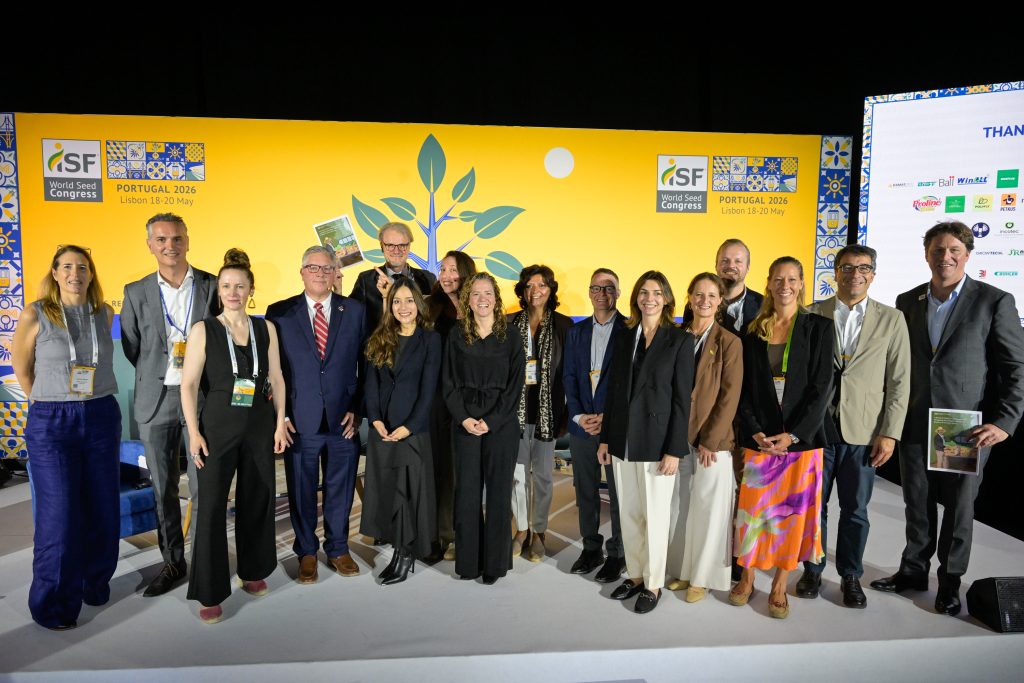
The session concluded with the launch of ISF’s new Social Rights Guidelines, a practical framework and checklist designed to help seed companies of all sizes strengthen ethical labor practices, which builds on the excellent work already being done by many seed companies.

Developed as a voluntary and practical resource, the guide is designed to help seed companies, suppliers, associations, and teams working across sustainability, compliance, procurement, human resources, and production strengthen responsible labor practices throughout seed value chains. It complements existing social responsibility and responsible sourcing programs, with a strong focus on awareness-raising, capacity building, and continuous improvement.
The guide is also accompanied by an e-learning course, allowing companies and associations to use it for staff training, onboarding, and internal dialogue on social rights and ethical business conduct. In this way, the guidelines translate broad sustainability principles into accessible tools that can support practical action across companies of different sizes and at different stages of their sustainability journey.#