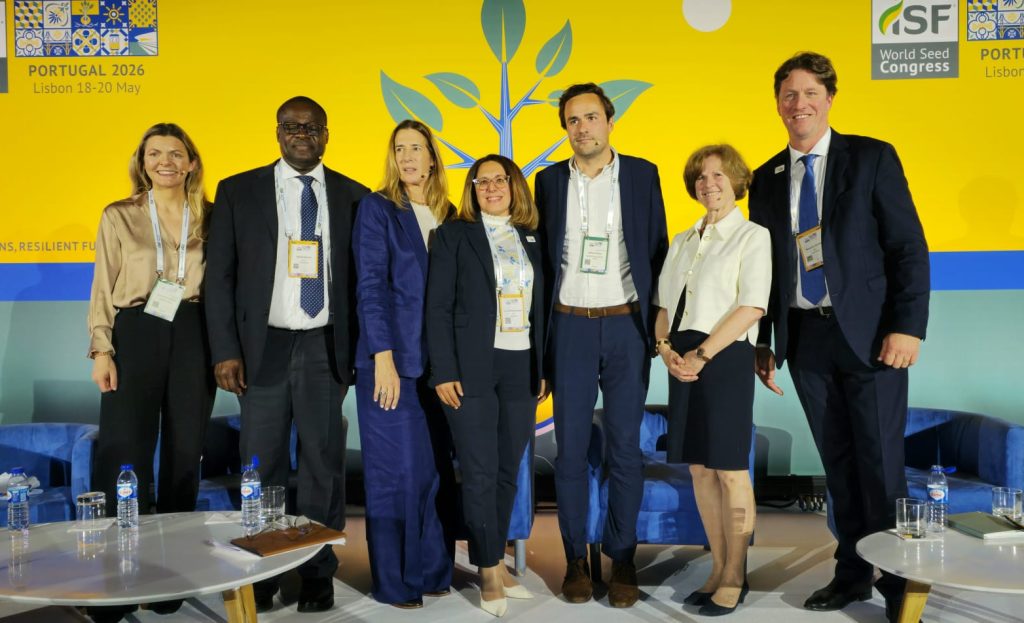
At the World Seed Congress panel discussion on markets in Lisbon, one message came through clearly: disruption is no longer an exception for global trade. It is part of the operating environment.
In the panel discussion “Shocks, Shifts & Silver Linings: What’s Ahead for Global Seed Markets?”, experts from the World Trade Organization, Business at OECD, farming, and the seed sector explored how geopolitical tensions, worsening climate change, shifting trade relationships, and market volatility are reshaping the way seed moves around the world.
The discussion, moderated by Susannah Savage, Agriculture and Commodities Correspondent of the Financial Times, was frank about the challenges mentioned above. But it also pointed to a clear opportunity: in a disrupted world, the seed sector has a central role in ensuring that agri-food systems are resilient.

Dr. Edwini Kessie, Director of the Agriculture and Commodities Division of the WTO, in his keynote address, emphasized that, despite persistent turbulence, the rules-based multilateral trading system continues to provide stability. Global agricultural trade is valued at around USD 2 trillion, and a significant share of global trade (72%) still operates on a Most-Favored-Nation basis. For the seed sector, this matters. Seed is a critical input in agricultural production and is one of the most internationally connected agricultural inputs, often moving across borders for breeding, testing, multiplication, treatment, certification, and distribution before reaching growers and farmers.
Uncertainty as the new norm
Predictable trade rules are therefore not abstract policy instruments. They are part of the infrastructure that allows farmers to access the right seed at the right time.
“We have moved from a world of cooperation to a world with many disruptions. I think it changed a lot of things for our business. It forces us to be more agile.” — Arthur Portier, Argus Media
“Trade uncertainty is the new norm. It has happened for the last couple of years and that’s not just for the seeds industry, it’s for business broadly.” – Hanni Rosenbaum, Business at OECD

At the same time, the panel made clear that trade uncertainty is now the new norm. Geopolitical shifts, rising freight costs, the current fertilizer price volatility, and changing market access conditions are already affecting decisions across the value chain. Arthur Portier, a farmer and consultant at Argus Media, said farmers are adjusting crop rotations in response to current volatility. Seed companies, meanwhile, are rethinking supply chains. Businesses must become more agile, more diversified, and more attentive to risk.
Climate change adds another layer of complexity. More frequent droughts, floods, heat stress, and pest pressures are changing what farmers need from seed. Lorena Basso, ISF Vice-President (elected President in Lisbon) and President of Basso Semillas, framed this challenge as a call to action for the seed sector. Climate change is a serious threat, but it also reinforces the value of innovation, particularly climate-resilient breeding and seed technologies that help farmers adapt and protect yields.

Hanni Rosenbaum, Executive Director of Business at OECD, highlighted that innovation is already changing the equation. Since 1990, agricultural output in OECD countries has increased while land use has decreased, showing how technology and productivity gains can support more sustainable agriculture. For the seed sector, this is a powerful reminder that improved varieties and better genetics, coupled with seed-related innovations, are essential to producing more with less.
The future of multilateralism
Looking ahead, the panel expressed cautious optimism about the future of multilateralism. Trade rules must evolve to address modern challenges such as digital trade, subsidy reform, sustainability, and food security. But countries continue to recognize the value of a system that provides predictability, fairness, and cooperation.
“Challenges are opportunities. The opportunity is how to increase food, how to increase fuels, and how to increase feed. So that is our challenges, and innovation is key to solve these.” – Lorena Basso
“With trade negotiations stalled, organisations like ISF can play a valuable role in helping to unlock progress.” – Dr. Edwini Kessie, WTO
In an uncertain world, seed remains one of the most practical sources of stability and resilience. The task ahead is to keep it moving, keep innovating, and keep it accessible to the farmers who need it at the right time.
For further information on this topic, please contact Dr. Khaoula Belhaj Fragnière of the ISF Secretariat.#